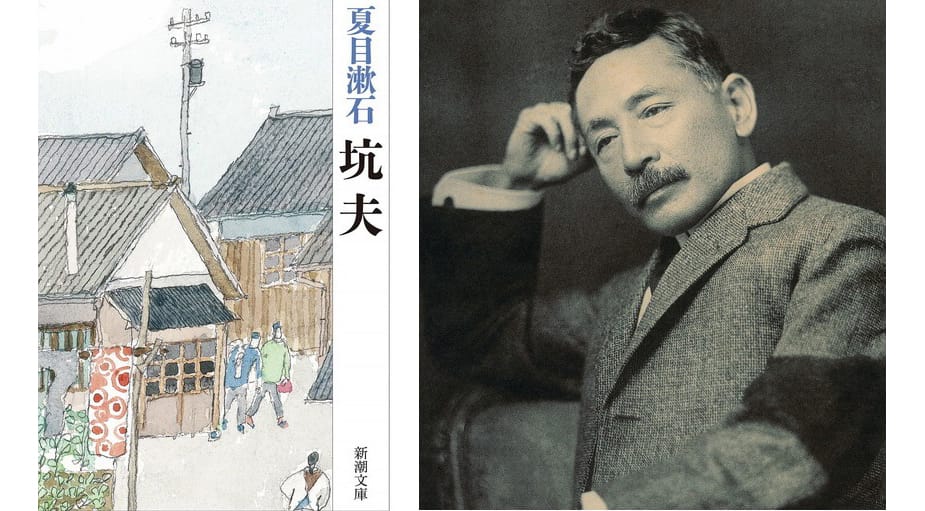
«Ваш покірний слуга кіт», «Серце», «Сансіро», «Потім» — оце знаний в нас Сосекі Нацуме. Трохи повчальний, трохи іронічний, дуже «правильний» класик. Такий, що легко вписується в програми й репрезентує «кризу особистості доби Мейдзі». Як на мене, в наш час нуднуватий (за винятком «Кота») письменник-реаліст.
Але є в нього роман «Гірник», він стоїть осібно. Нічого подібного в японській літературі 1900-х просто не існувало. Та й не лише в японській.
Юнак тікає з дому й спускається в мідну копальню. Нормальна зав’язка роману. Зараз буде соціальна драма, майже соцреалізм, «дно життя». Або Bildungsroman, моральне переродження і «ріст над собою». Авжеж.
Натомість починається дивовижа. Роман уперто відмовляється бути романом. Події не складаються в сюжет. Люди не стають персонажами. Шахта не обертається на символ з готовим значенням. Ніхто нічого не «усвідомлює». Герой не змінюється.
Є тільки рух. Темний, монотонний, задушливий рух свідомості.
Герой пливе крізь шум, втому, бруд, уривки думок, механічні враження — секунди «в реальному часі» розписані на сторінку. Який це ранній модерніст на машині часу заблукав у Японію доби Мейдзі?
Перекладач «Гірника» англійською Джей Рубін згадує, з певними застереженнями, «потік свідомості». Згоден: це ніби література, що виникла раніше за саму можливість такої літератури (гаразд, гаразд, Дюжарден вигадав «внутрішній монолог» на двадцять років раніше, тільки ніхто в Японіх його тоді не читав). Не Джеймс Джойс, ні. І не Вірджинія Вулф, але знайоме, й тому падає в «моторошну долину».
Нацуме більше такого не писав. Узагалі. На мить кудись провалився — і повернувся. До психологічних романів, моральних дилем, інтелігентів, закоханих студентів і всього того, за що його тепер люблять (або ні).
А «Гірник» лишився. Самотній, незручний, майже без аналогів. І разюче сучасний. Розсіяна, виснажена свідомість героя, який безвільно рухається крізь нелюдський механічний світ, значно ближча за класичний (актуальний 120 років тому) «роман виховання».
В Японії буває: письменника пам’ятають за сакурою й моральними кризами, аж раптом виявляється, що він автор тексту, який випав із майбутнього.
Перекладати таке вкраїнською нема кому, а для знавців англійської наводжу фрагмент.
* * *
Climbing ten or fifteen feet down terraces cut in the earth, I came to where Hatsu was standing. He turned to the right. Another set of terraces went down twenty-five or thirty feet. At the bottom of those, Hatsu turned to the left. There were more terraces. Turning right, left, right, left, we zigzagged like a bolt of lightning down one level after another—how far down into the earth, I have no idea. It was my first time along this route, of course, and in the darkness of the mine it felt awfully long to me. When we had climbed down to the lowest level, where, it seemed, almost all ties with the world had been lost, we suddenly entered a room perhaps twelve feet by twelve. This «room,» of course, was just a place where the tunnel had been dug out more broadly, the walls of which swelled outward beyond the limits set by the floor and ceiling. It was as if we had fallen into a huge earthenware sake jar. I found out later that this was what they called a work site. They would widen the tunnel like this when an engineer had concluded that a vein of ore was present. The work sites were naturally broader than the passages, and each would be worked by a team of three miners on contract. Sometimes a work site estimated to require two weeks would be finished in four days, and others judged to need no more than five days they’d dig for half a month or more. In this way, roads would be dug in the mine, and if by a road they found a vein, they would dig out that spot, following wherever the vein led. This is why the entrance where the trains ran might be level and the tunnel there a single straight line, but once the mine turned down and came to Checkpoint No. 1, branch roads ran off to the right and left with work sites established at scattered points. After a work site was finished, they would find more veins and dig wherever those led, as a result of which the mine was a mass of narrow passages and dark holes—probably something like an ants’ nest. Or it might be compared to the way worms tunnel through a book. Human beings would eat the copper in the earth, and when they were finished eating they would find more copper and go to eat that, as a result of which these roads had been dug every which way. You could go on and on through the mine without ever encountering a miner unless you came to a work site. You’d hear clanging sounds now and then, but by themselves these only made the place seem all the more deserted. Hatsu had apparently been taking me on detours to avoid the work sites, probably because I was here mainly to see what the place looked like inside. I actually saw miners at work for the first time only after we came to the bottom of this long series of terraces. No matter how far we climbed down the lightning-bolt zigzag, it had never seemed to end and we never encountered anyone along the way, so when we entered a work site for the first time and met real, live human beings, I was overjoyed.
They were sitting on a log. There were three of them. The log had been stripped of its bark and polished. About the size of a railroad cross-tie, it was big and heavy. I couldn’t imagine how they had managed to transport it this far. These things were left in the work sites by the setters to shore up the ceilings, in order to prevent cave-ins when the dug-out areas expanded. Two of the men were actually sitting on the log and the third was squatting down and facing it. In the space between them was a small wooden tub. It lay on the ground, inverted. The third man was pressing it down. All three men were emitting strange cries. The man suddenly lifted the tub, revealing a pair of dice. That was the moment when Hatsu and I entered the room.
The three men raised their eyes in unison, looking at me and at Hatsu. A lantern had been fastened to the earthen wall. Its dark light shone on the three sets of flashing eyes. Nothing flashed but those eyes—really. The room, of course, was dark. The lantern, which by rights had to be bright, was dark. The way it smoldered, giving off murky smoke, it looked like a cloudy liquid that moved. No sooner did its cloudy tip blacken and turn into smoke than the smoke was sucked into the darkness. For this reason, the interior of the room was hazy. And it moved.
The lantern was fastened above the three men’s heads. Which is why the only parts of the men that could be seen with some clarity were their heads. But since the three heads were black, they were practically invisible. The effect was especially strange because the three heads had been clustered together, but the moment I entered the room they drew apart. The tub had appeared from among them. And the dice had appeared from beneath the tub. Having seen the tub and the dice and heard the three men’s strange cries, I had next seen their faces—faces I could barely make out. Of one man’s face, only the tip of a cheekbone and a wing of the nose caught the light. Half the brow of the next man shone through. The whole face of the third was dimly visible, but this was because it received light from my own lantern, some four or five feet away from him. In this pose, the three fixed their eyes with a flash—on me.
Filled with joy though I was at having met up with other human beings at long last, the moment I saw these three sets of eyeballs, I stopped dead in my tracks.
Ще в серії «Несподівані класики»: